Bubble Word Jam
- 4.6
- Rating
- 1.00M
- Installs
- Free
- Price
 Analysis by App-foxy
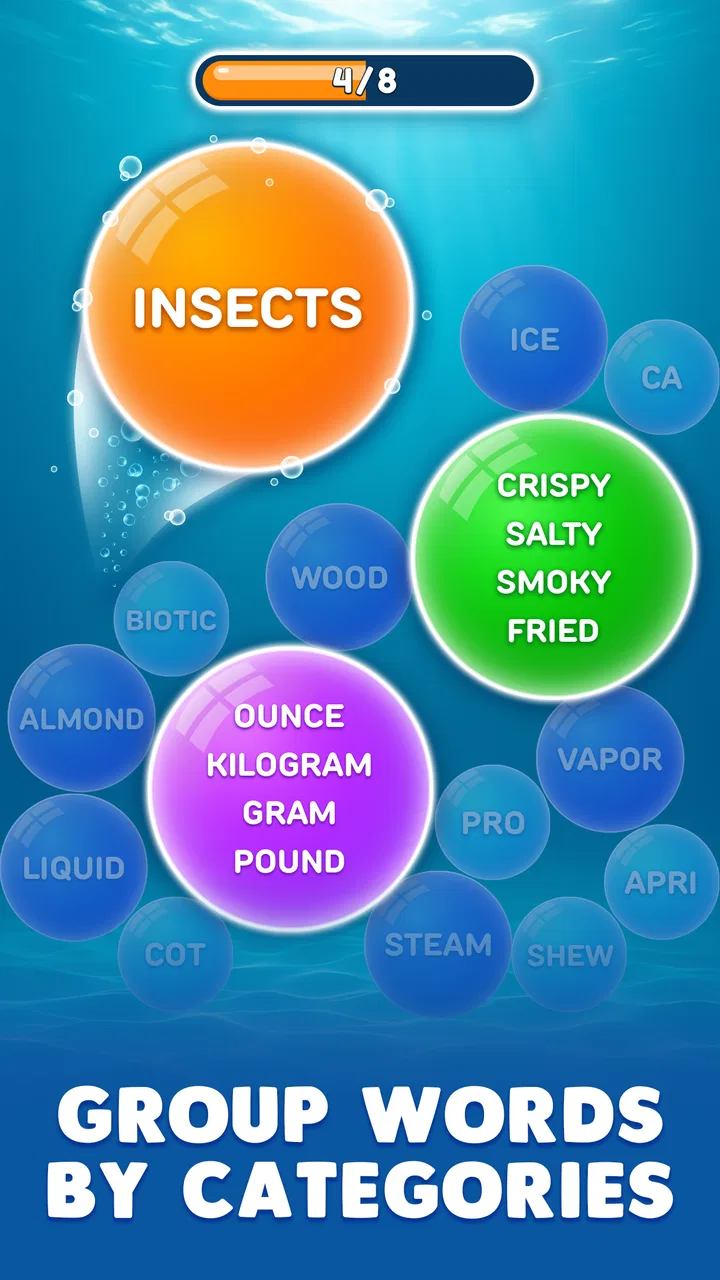
Bubble Word Jam is the kind of word game I can open for a few minutes without needing to learn a complicated system first. The idea is easy to understand: words appear as bubbles, and I look for four that belong together before clearing them. That simple rule creates a surprisingly careful puzzle, because the obvious connection is not always the correct one. A word may fit several themes, while another may be there to distract me from the group I should really be building.
I reviewed it as a casual player who enjoys vocabulary puzzles but does not always want a long session. My first impression is that this is best approached as a focused sorting game rather than a traditional spelling challenge. I am not trying to type the longest word or race through a dictionary. I am trying to recognize relationships, resist premature guesses, and make each selection with enough care to avoid boxing myself in.
That makes Bubble Word Jam appealing for short breaks, quiet evenings, and anyone who likes the satisfaction of spotting a hidden pattern. It is free to start, although it includes optional in-app purchases ranging from $1.99 to $99.99 per item. The important question for me is not simply whether the game costs nothing to install, but whether the puzzle design remains enjoyable without encouraging me to spend. I will return to that point because it matters more here than a quick glance at the colorful format might suggest.
You May Also Like

 AccuWeather: Weather Radar
AccuWeather Review: A Quick, Clear Forecast for Everyday Decisions
For everyday plans, the best forecast is the one you can understand quickly. AccuWeather makes rain timing, radar, and local conditions easy to act on, with a few trade-offs.

 Hill Climb Racing
Why Hill Climb Racing Still Turns Crashes Into One More Run
A tiny car, a bumpy hill and one more upgrade: Hill Climb Racing keeps resurfacing because its simple chaos makes every near-miss feel personal.

 AliExpress - Shopping App
AliExpress Makes Global Shopping Feel Personal, but Shoppers Bear the Risk
AliExpress turns a global marketplace into a pocket-sized discovery engine. Its reach is useful, its shopping loop compelling, and its trade-offs easy to miss.

 Lords Mobile: Kingdom Wars
Lords Mobile Is a Kingdom-Building Routine, Not a Quick Match
A case-by-case verdict on the building, battles, device demands, and social commitments that make Lords Mobile rewarding for some players and exhausting for others.

 PDF Scanner app - TapScanner
TapScanner Makes Paperwork Easier to Capture, Check, and Share
TapScanner makes scanning with a phone feel less like a rescue operation and more like a dependable step in getting work done. Its capture tools are useful, though not flawless.

 Block Blast!
 Shows How Much a Puzzle Game Can Leave Out
A quiet grid game shows why puzzle players increasingly value instant clarity, repeatable skill and low-pressure play—and where the genre still needs to catch up.
More From Our News Desk
View All News


How the word grouping works in practice
I find the grouping mechanic most rewarding when I treat each board as a small process of elimination rather than a race to tap the first promising set. I look for words that could plausibly fit more than one theme, then hold those back until the rest of the board gives me a clearer read. That approach makes uncertain choices easier to manage and leads naturally into the question of how the game feels during a longer stretch of play.
A simple rule with room for misdirection
The central task is to identify four words that share a category and burst their bubbles. On paper, that sounds more straightforward than it feels during play. The challenge comes from the overlap between possible meanings. A word can appear to belong with one set because of its everyday use, while the intended relationship may be based on a different meaning, a familiar phrase, or a narrower subject.
I found that the most useful habit is to avoid committing to the first group that looks plausible. Instead, I scan all the visible words and mark the relationships mentally. If three words clearly connect, I treat the fourth as a test rather than an assumption. This small pause prevents a common mistake: building a category around a strong-looking trio and then forcing an unrelated word into it.
The bubble presentation gives each decision a little more weight than a plain list would. Selecting words feels like making a move, not merely highlighting text. That makes successful groups satisfying, but it also means that a careless tap can interrupt the rhythm of solving. Players who prefer completely relaxed experimentation may find the format slightly tense, especially when several words seem to overlap.
Why vocabulary is not the only skill involved
You do not need an enormous vocabulary to enjoy this game, but vocabulary alone will not solve every board. Pattern recognition, general knowledge, and the ability to change direction are just as important. I often get further by asking what kind of category the puzzle might be using than by staring harder at one difficult word.
A practical approach is to separate words into confidence levels. I treat a pair with a clear connection as a clue, a trio as a possible answer, and a full group as something to confirm only after checking the remaining choices. This is one of the more valuable lessons the game encourages: certainty should come from the whole board, not just from an attractive partial match.
That method also makes the game more approachable for people who sometimes worry that word games are tests of education. A missed group does not necessarily mean I failed to understand a word. It may mean I read the relationship too narrowly or overlooked a second possible category. The game rewards flexible thinking, which gives it more depth than a basic vocabulary quiz.
Useful play habits for short sessions
Bubble Word Jam works well when I have a few spare minutes because one puzzle can be treated as a complete mental exercise. I do not need to prepare a notebook or remember a long story. I can start by scanning for obvious categories, then use the leftovers to reveal the more subtle connection.
My favorite technique is to begin with the least ambiguous words, but not immediately burst every group I notice. I first use them as anchors. Once I know that a word has a strong relationship with two others, I inspect the fourth candidate and ask whether the remaining words become more coherent if I leave it alone. This reduces the chance of solving one group while accidentally destroying the clues needed for another.
Another useful habit is to reconsider familiar words in less familiar roles. A common noun may also be a name, a verb, part of an expression, or a reference from a particular area of knowledge. I would not call this a hidden mode or advanced feature; it is simply the kind of reasoning the puzzle naturally demands. Still, it is a concrete way to improve rather than relying on random tapping.
Where progress can feel comfortable or pressuring
The game’s basic structure is easy to enter, but my sense of pressure depends on how much I care about solving a board cleanly. When I am playing casually, an uncertain group feels like a small puzzle to revisit. When I am trying to maintain momentum, the same uncertainty can become frustrating because every tempting connection competes with another.
This is an important distinction for potential players. If you enjoy word games because they let you make educated guesses without consequences, you may want to play Bubble Word Jam slowly and treat mistakes as part of the process. If you prefer a calm game with no mental friction at all, the category ambiguity may feel more demanding than the cheerful bubble format suggests.
I also think the game is better suited to deliberate progress than to endless background play. It asks for attention. Playing while distracted, watching television, or switching between several tasks makes the relationships harder to see and can turn a fair puzzle into an irritating one. A short, focused session is more rewarding than leaving it open while barely thinking about the board.
Spending, fairness, and what the purchase range means
The game is free to download and play, with optional purchases listed from $1.99 to $99.99 per item. That is a wide range, so I would advise anyone considering a purchase to inspect the exact item and its purpose before confirming anything. The existence of a high-priced option does not by itself prove that spending is required, and I would not assume that every player will encounter the same purchase prompts in the same way.
From a fairness perspective, the key issue is whether a player can enjoy the word-solving loop without paying. Since the core appeal is the act of finding categories, I would personally judge the game first by how satisfying the free experience feels, not by the presence of optional extras. I also would not spend simply because I was stuck on one board. Taking a break and returning with a fresh view is often a better strategy for this type of puzzle than treating payment as a shortcut.
Players who are comfortable making occasional purchases may appreciate having optional ways to support the game or handle a moment of friction, but the listed range means budgeting matters. I would especially recommend caution for younger users, even though the content rating is Teen. A parent or guardian should understand that free installation and optional purchases are separate parts of the experience.
The developer is Bayram Torayev, and the current version is 0.9.3. That version information is useful when troubleshooting or comparing your experience with someone else’s, but I would avoid assuming that every future update will preserve the same balance, interface, or purchase presentation. Word games depend heavily on the quality and fairness of their puzzle sets, so continued refinement can make a noticeable difference.
Is it competitive, and is competition fair?
I would not choose this game primarily as a competitive title. Its strongest appeal is personal problem-solving: I see a board, form hypotheses, and try to uncover the intended groups. That makes it different from word games built around head-to-head speed, shared rankings, or direct score chasing. If your main goal is to beat friends in real time, a multiplayer word alternative may be a better match.
There is also a fairness question inside each puzzle. A good board should make the answer feel understandable after the connection becomes clear, even if it was difficult beforehand. The danger with category games is that a group can feel arbitrary when the relationship is too narrow or when several alternatives appear equally valid. I pay attention to that distinction: challenge is enjoyable when I can learn from the solution, while ambiguity without a satisfying explanation feels less rewarding.
For solo players, the absence of direct competition can be a positive. I am not pressured to match another person’s speed, and I can use a slower method without feeling behind. For players who need visible goals, streaks, leaderboards, or social comparison to stay engaged, the basic grouping loop may not provide enough motivation on its own.
How it compares with familiar word-game alternatives
Compared with crossword puzzles, Bubble Word Jam is more immediate and less dependent on filling a grid from intersecting clues. I do not need to maintain a long chain of answers or understand a clue’s exact wording. The trade-off is that the category relationships can be broader and more interpretive than crossword clues.
Compared with anagrams, it tests association more than letter manipulation. Players who love rearranging tiles to discover a hidden word may find the grouping mechanic less tactile, while people who enjoy sorting ideas may prefer it. It also differs from a daily guessing game because the satisfaction comes from resolving several relationships on one board rather than narrowing down a single answer through repeated attempts.
Compared with a traditional word search, the challenge is conceptual rather than visual. I am not scanning for a word hidden among letters; I am deciding which meanings belong together. That makes the game a better choice for someone who likes classification and a weaker choice for someone who wants a soothing, almost automatic activity.
Who will get the most from it
I would recommend it to casual puzzle players who like language, general knowledge, and the moment when a confusing set suddenly becomes organized. It is also a good fit for someone who wants a game that can be played in compact sessions without committing to a large campaign or complicated controls.
It may be useful for families or friends who enjoy discussing possible categories, although I would keep the Teen content rating in mind when deciding whether it suits a younger player. The game can create good conversation because two people may see different connections in the same set of words, then compare which interpretation leaves the cleanest remaining board.
I would be more cautious about recommending it to players who dislike uncertainty, want every answer to be immediately obvious, or expect a clearly competitive structure. It is also not my first choice for someone seeking a deep narrative, action, or long-term character progression. Its appeal is concentrated in the quality of the word relationships and the satisfaction of sorting them correctly.
What I would check before committing time or money
Because the game is relatively new, I would approach it with reasonable expectations rather than assuming it already has the breadth of a long-established word platform. Its release date was September 8, 2025, and the public response so far is encouraging: it holds a 4.7 average from over 500 ratings, with more than 30 written reviews and over 10 thousand installs. Those figures suggest genuine early interest, but they are not a guarantee that every puzzle will match my preferred difficulty or style.
The minimum operating-system requirement is Android 7.0, which makes it accessible to many older Android devices. If you are using an iPhone or another platform, I would check the relevant store page before planning your download, since device compatibility and purchase handling can vary by platform. I would also keep the app updated when possible, particularly because an early version can change as the developer responds to feedback.
My spending rule would be simple: play enough free content to decide whether the grouping mechanic itself holds my attention, then consider a purchase only if its purpose is clear and fits my budget. I would not treat the top end of the purchase range as a normal cost of entry. The game is advertised as free, and optional spending should remain optional in my personal decision-making.
My trust verdict after playing
Bubble Word Jam earns my recommendation as a focused, accessible word puzzle with a stronger reasoning element than its bright bubble presentation initially suggests. I like that the basic action is easy to understand while the actual decisions require restraint. The best moments come from rejecting a tempting connection, examining the leftovers, and finally seeing why four words belong together.
My reservation is not about the premise; it is about how much the long-term experience will depend on consistent puzzle quality and a purchase approach that feels comfortable to free players. The optional price range deserves attention, especially for households where purchases need to be controlled. I would also avoid presenting the game as a competitive replacement for multiplayer word titles, because its main strength is individual solving rather than direct rivalry.
For me, the right way to use it is as a small daily mental break: open a board, slow down, test the categories, and stop when the puzzle stops being fun. If you enjoy word association and can accept that some answers may require a broader perspective than expected, this free game is worth trying. If you want a completely pressure-free activity or a social contest, another word-game format may serve you better. My final verdict is positive, with one practical condition: enjoy the puzzles first, and treat every optional purchase as a separate decision.
FAQs for Bubble Word Jam
01What is Bubble Word Jam and how does it work?
Bubble Word Jam is a word puzzle game that challenges players to form words from a set of letters presented in bubbles. Players swipe across the letters to create words, advancing through levels as they successfully complete each puzzle. The game is designed to enhance vocabulary and improve cognitive skills while providing entertainment.
02Is Bubble Word Jam free to download and play?
Yes, Bubble Word Jam is free to download and play. It is available on both Android and iOS platforms. However, the app may offer in-app purchases for additional features or to remove ads. Players can enjoy the core gameplay without spending money, but some enhancements might require payment.
03Are there any age restrictions for playing Bubble Word Jam?
Bubble Word Jam is suitable for players of all ages. The game’s straightforward mechanics and educational value make it particularly appealing to both children and adults seeking a fun way to improve their vocabulary. Parents can feel comfortable allowing their children to engage with the game, knowing it offers educational benefits.
04How does Bubble Word Jam handle in-app advertisements?
Bubble Word Jam includes in-app advertisements as part of its free-to-play model. Ads may appear between levels or during gameplay but are designed not to disrupt the gaming experience excessively. Players have the option to purchase an ad-free version through in-app purchases if they prefer an uninterrupted experience.
05Can I play Bubble Word Jam offline?
Yes, Bubble Word Jam can be played offline once it is downloaded and installed on your device. This feature makes it convenient for players who want to enjoy the game without requiring a constant internet connection, perfect for travel or areas with limited connectivity.
Pros
- Engaging word puzzles boost vocabulary.
- User-friendly interface for easy navigation.
- Daily challenges keep gameplay fresh.
- Offline mode available for on-the-go play.
- Colorful graphics enhance the experience.
Cons
- In-app ads can be distracting.
- Limited hints without purchases.
- Some levels feel repetitive.
- Occasional glitches in older devices.
- Lacks multiplayer or social features.

Bubble Word Jam
Gallery